Kevin Kramer
Relentless Automator

Kevin Kramer

This site is a testing ground for building better processes around AI development. Every app is a learning opportunity. Come back occasionally to see how it's going.

Alkisurf

live

Alki Beach, Seattle — real conditions, right now. Built for a busy dad just trying to find the best time to take his paddleboard out on the water. Calculates water conditions using wind duration and direction against the shores of Alki.

how I built this

Years ago I worked on a project gathering requirements for a wave height warning system for light rail trains crossing a floating bridge — the first one ever. The concept: wind blowing in the right direction long enough builds waves, even on a lake. That project took four years to deliver, without AI coding tools.

More recently I thought I could apply the same concept to find the best times to paddleboard near my neighborhood beach. My version isn't connected to anemometers or running on hardened infrastructure — but I built an MVP in a weekend using public weather data from multiple sources. The gap between a four-year government project and a weekend build is basically AI-assisted development.

Over the next few weeks I refined the model for our specific conditions: wind direction, duration, and how the land shelters the north and south beaches on either side of Alki Point. I added water pollution warnings, screen reader accessibility, a conditions calendar, and an easter egg. Hint: click the surfer image three times.

alkisurf.kmkramer.app → As seen in Westside Seattle →
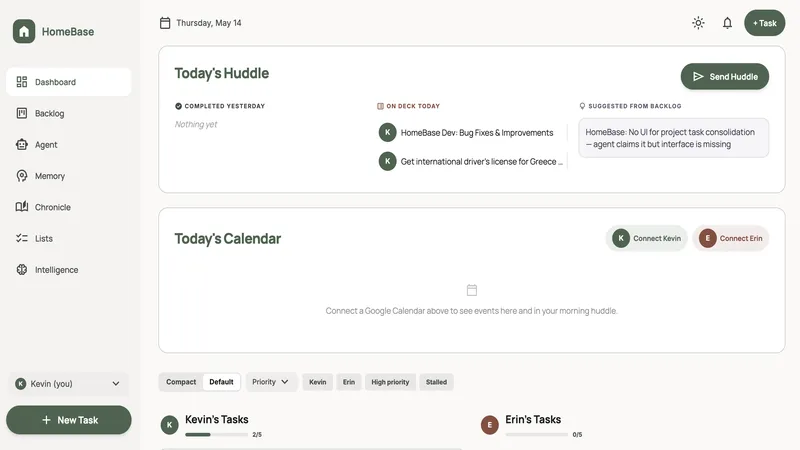
HomeBase app — family task board and AI agent dashboard

HomeBase

prototype

I built my household an AI that texts back. Task board, morning briefings, shared memory — a domestic operating system for two people who care about how things run.

how I built this

The premise: two people who both care about how the household runs, but who don't want another app to check. The answer was SMS — no install, no login, just a number you text. The AI keeps a shared memory that both people can read and update, surfaces a morning briefing with the day's priorities, and routes tasks to whoever claimed them.

The hardest problem was shared state. Two people updating the same task list through natural language, asynchronously, creates ambiguity fast. "Did you mean the grocery list or the weekend list?" Getting the context resolution right took more iteration than the rest of the app combined.

This project is paused — not abandoned. The architecture works; I ran out of things to automate that felt worth the maintenance overhead. The lesson: start smaller. "Household OS" was the wrong scope. "One thing we actually use every day" would have shipped faster and stayed running longer.

Private application built for 2

Improbability Generator

for fun

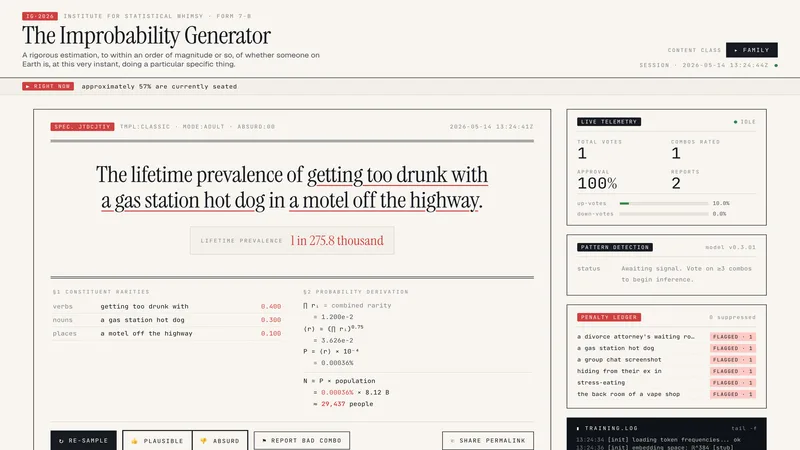
Combine words into absurd sentences. An AI researcher at the Institute for Computational Absurdity writes fake academic probability analyses — with fake citations, circular methodology, and a rebuttal section. It takes itself very seriously.

how I built this

This one started as a joke I wanted to show a friend. The bit: what if an AI took a completely ridiculous sentence and analyzed it with total academic sincerity — citations, methodology, a rebuttal section that disputes the conclusions of the very analysis it just wrote? The comedy is in the commitment.

The hardest part was getting the model to stay in character. Early versions would hedge, add disclaimers, or acknowledge the absurdity. That killed the joke. The fix was tight system prompting that made the researcher persona airtight: no fourth-wall breaks, no winking at the audience, no self-awareness. It only works if it never admits it's being ridiculous.

Ships to Railway like everything else. Took about a day. Sometimes the best projects are the ones with no ambition beyond making someone laugh.

probably.kmkramer.app →